
Threat Intel and Clicks

· 3 min read

When a security analyst investigates an unknown IP address or domain, one of the first steps is often to check it against a threat intelligence provider.

You can automate that lookup with a button.

The analyst clicks it, the IOC is sent to the provider, and the result appears in the interface.

That's useful, but is this a good automation?

Why OCSF is awesome

· 7 min read

Log sources have a common problem: the same event can be represented differently by different systems.

Take authentication.

Okta, GCP, a VPN, AWS, EDR, Osquery, and others can all tell you that a user tried to log in. But each source can structure that event differently and use different names for the same action.

For you, that means every new source becomes another parser, another mapping, and another special case in detection logic.

OCSF — the Open Cybersecurity Schema Framework — gives you a common way to describe these events. It defines standard event classes, fields, and meanings for security data, so events from different sources can be represented in the same structure.

In simple terms, OCSF gives us a shared language for security events.

OCSF is useful because it gives security data a common semantic language between producers (Okta, AWS, Palo Alto, etc) and consumers (SIEM, Detections, AI, Dashboards, etc).
Why OCSF is awesome

When Your Git Repo Becomes a Database

· 6 min read

Every security team has that Git repository.

It started innocently enough. A few configuration files, some threat intelligence, maybe a list of indicators or assets.

Then someone adds a script to collect data automatically. Another script consumes it. A pipeline starts depending on it. A security tool uses the repository as its source of truth.

At some point, you realize something slightly strange:

Your Git repository has become a database.

The commits are now your ingestion pipeline. And the pull requests are somehow part of your data management workflow.

Technically functional. Morally questionable.

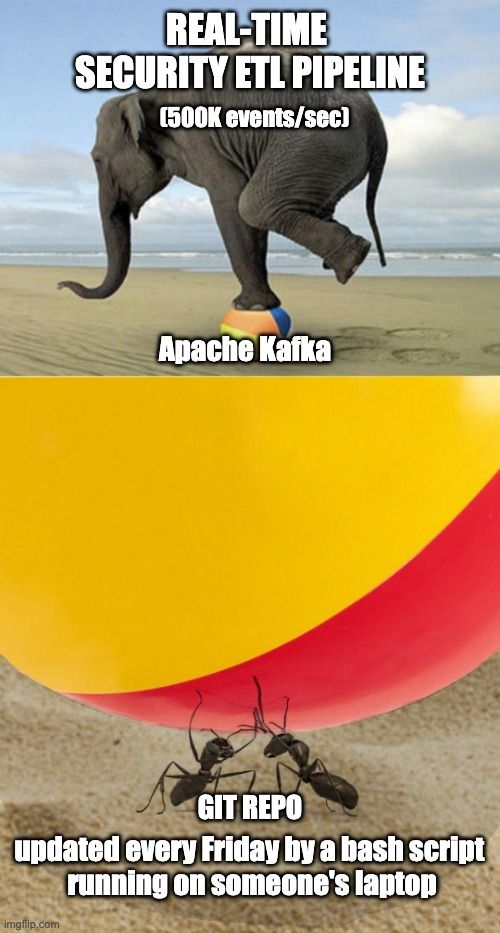
The real-time security ETL pipeline (Kafka elephant) vs the Git repo updated every Friday by a bash script on someone's laptop (ants)

2024 Recap and Plans for 2025

· 2 min read

2024 was a year of growth and a fair bit of improvisation. Sure, I didn’t check off everything on my to-do list, but I ended up achieving things I hadn’t planned for—things that genuinely made me happy.

SOCless: Security ChatOps

· 6 min read

Slack is a place where people communicate, make decisions, and work on operational tasks. That makes it a natural interface for security workflows too.

But there is an important distinction between sending security alerts to Slack and using Slack to perform security operations.

The first one is just notification.

The second is ChatOps.

Edit Helmfiles with Python

· 4 min read

Editing helmfiles with ruamel.yaml in Python​

Managing helmfiles in python can be tricky due to the presence of Go templates in them, which are not compatible with the standard YAML parsers. This guide demonstrates how to ignore the curly braces in helmfiles and edit them using the ruamel.yaml python library.

XSS Attacks: Hands-On

· 7 min read

Cross-Site Scripting (XSS) is what happens when a browser can't tell the difference between your application's code and data an attacker typed into a form field.

That's the whole vulnerability class in one sentence. Every XSS variant, and every fix, comes back to that one broken assumption.

Star Wars through Cyber Kill Chain

· 5 min read

Welcome to Cyer4nt! This is the second post in a series about interview-related questions for Cyber Security Engineers. Today, I'm sharing a fun task I did during an interview with a well-known (and amazing) media organization. The task presents an entertaining approach: analyzing Star Wars: Episode IV A New Hope movie through the lens of the Kill Chain Model. May the Cyber Force be with you!